


Embodied intelligence and humanoid robots are moving the discussion from “getting it to move” to “delivering it reliably at scale.” Behind demos frequently referenced at events such as CES—such as Atlas—an increasingly clear industry consensus is that, once robots enter real operating conditions, the differentiator is not only algorithms and mechanical structure, but also the less visible engineering details that determine reliability—such as rotary interconnects inside joints. For embodied systems, a joint is not only a motion unit, but also a rotary channel for data and power. When interconnect stability degrades, the typical outcome is not “completely unusable,” but intermittent, hard-to-reproduce anomalies—while troubleshooting and maintenance costs rise rapidly with operating time.
In a typical humanoid architecture, there are multiple natural rotary interconnect nodes. Commonly discussed locations include the neck, waist, both wrists, both hip joints, and other key rotary joints in the upper limbs. These locations share a core engineering challenge: tight space constraints, while requiring both real-time communication links and power delivery to pass reliably across a rotating interface. Traditional cable-harness solutions must deal with torsion, drag-chain fatigue, and connector loosening. Mechanical slip rings are mature, but wear, maintenance intervals, and long-term consistency remain variables that must be carefully weighed for volume delivery.

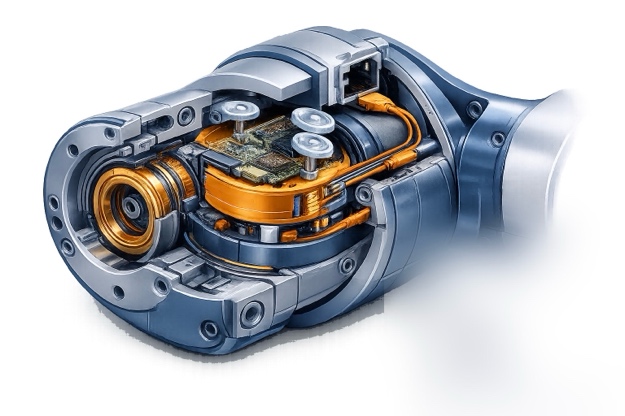
Against this backdrop, DECO has recently released an mmWave wireless EtherCAT module for embodied-robot rotary-joint scenarios—SDKT1020-P020-FETN. Using contactless mmWave rotary transmission, the module is designed to improve reliability and determinism in joint-internal interconnects. Based on DECO’s in-house mmWave wireless connectivity chip and circularly polarized antennas, it enables contactless bidirectional data transmission across the rotating interface. At the same time, it integrates contactless power transfer into the same interface, forming an integrated “data + power” rotary interconnect. It supports bidirectional full-duplex real-time transmission for Ethernet / EtherCAT / CAN, and is designed to simplify integration into joint-internal control networks. The goal is to reduce internal harnessing and rotary contact points, lower failure-point density and maintenance burden, and maintain consistent link behavior over a longer service life.
Based on publicly available product characteristics, the module is engineered to match joint-integration practices in power, form factor, and protocol compatibility. On the power side, it supports 12V–48V input and provides 5V / 3A output. In the standard configuration, contactless power transfer delivers up to 20W, covering power needs for joint-local control boards and common sensor loads. The power capability can be customized based on structure and thermal conditions, expandable up to 300W, leaving upgrade headroom for higher-power joint loads or end-effectors. On the communications side, it supports Ethernet / EtherCAT / CAN, covering 10/100/1000Mbps and aligning directly with typical robot real-time networking. With customized interfaces and mechanical configurations, the data rate can be extended up to 3Gbps, providing scalability for higher-bandwidth link requirements.
For embodied robots, the engineering difficulty is rarely about “good-looking specifications,” but about stability and consistency under rotary operating conditions. Accordingly, the module defines reliability targets for rotary scenarios: target BER < 10⁻¹², operating temperature range –25°C to 85°C, maximum speed up to 2000 r/min, and service life > 3 years. Mechanically, the module adopts a compact form factor to better fit within joint cavities and supports structure and interface customization to match installation boundaries and routing space across the neck, waist, wrist, hip, and other joint locations.
As embodied robots move from demonstrations to delivery, rotary interconnects inside joints are no longer simply about “making a connection,” but about engineering attributes that support reliability, maintainability, and consistent manufacturability at scale. With this mmWave wireless EtherCAT module, DECO targets the core needs of “reducing harnessing, lowering maintenance, and improving deterministic interconnect capability.” By converging data and power onto a single contactless rotary interface via mmWave rotary transmission, the module provides a modular option for key joint scenarios—helping systems achieve more stable and consistent interconnect performance during scale deployment.
For samples and technical inquiries, please contact sales@decosemi.com.
